


Or, Why My Bookshelf Isn’t Half as Organized as It Looks
This week, three different people—on three different Zoom calls—complimented my bookshelf.
Apparently, it looks very organized.
I said thank you, of course. But what I was thinking was: “If only you knew.”
Because that same bookshelf has been driving me crazy.
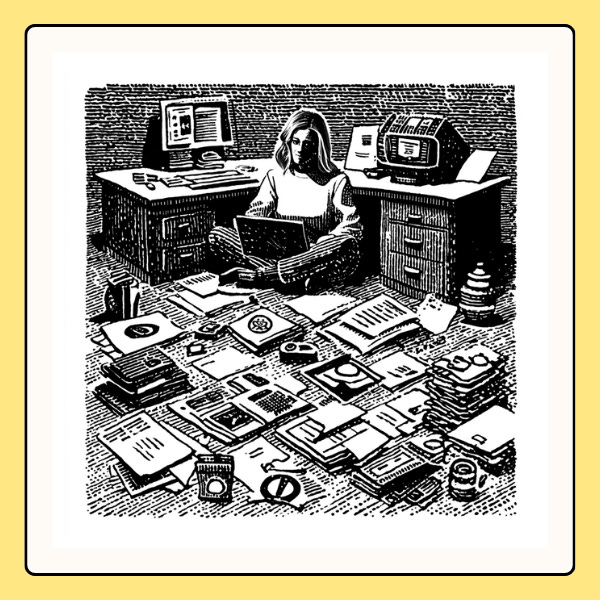
Twice this week, I went hunting for something I knew was there.
First, a book I wanted to share with a client. Gone.
Then, a photo of me as a little girl that I needed for a weekend retreat. Also gone.
I thought I’d find them in thirty seconds, but it took thirty minutes of flipping through albums, binders, and stacks of papers—nothing.
So yes, my bookshelf looks calm and collected on camera, but behind the scenes? It’s more “creative tornado” than curated library.
All this searching for lost things got me thinking about another kind of organization—how I keep things straight in my business. Especially the part that no one sees: how I use AI.
I thought I’d share the five ways I, a self-declared business management expert, lawyer, manager of a content-creation business, and easily distracted founder, organize my AI.
1. I Have a Chatbot That Actually Knows Me
I have a paid ChatGPT account with a custom profile that knows who I am, what I do, and how I like to be spoken to.
I can even tell it things like “never use an em dash.” (Does it listen? Not really. But a girl can dream.)
Having that setup means I don’t have to start over every time. It already knows my tone, my clients, and my weird fondness for parenthetical thoughts.
I also named it. Because, let’s face it, the thing is like a new puppy, houseplant, or car: it needs a name.
2. I Make Projects, Not Piles
When I’m working on something that takes time—like a workshop I’m planning—I keep all those chats inside one project.
That way, when I come back to it weeks later, I don’t have to re-explain what we were doing. I just pick up where I left off.
It’s like having perfectly labelled little file folders for all my ideas and chats rather than leaving all the papers spread out on the kitchen table.
3. I Automate My Repeatable Tasks
I’ve created dozens of custom GPTs for my repeatable tasks.
For example, my “Future Sonya” GPT. This one feels a little woo-woo, but it works. I loaded it with my values, goals, and priorities.
When I’m stuck on a decision, I ask her what she thinks. She doesn’t predict the future, but she reminds me of what matters most to me. It’s like talking to my wiser self on days I don’t feel very wise.
Others include GPTs that help me write titles and scripts for content creation, format my Substack (hi, you’re here), and stay consistent with my business values and voice.
4. I Reuse Prompts That Actually Work
Prompting is everything—it can make the difference between brilliance and gibberish.
So I keep a little library of good ones in a Notion database.
Things like:
• the prompt that helps me write better prompts
• the one that checks my grammar without changing my voice
• and the one that turns messy notes into something readable
It saves me from reinventing the wheel—and gives me more time to do things like search up and down for books and photos.
5. I Keep Learning About What I’m Using
I try to stay curious about what these AI tools (LLMs, to be more accurate) actually are. They’re not magical beings whispering universal truth. They’re just systems trained on a lot of data, and it’s risky for business owners to forget that.
The tool can be powerful, but equally dangerous if used without understanding.
So I read, follow the news, and keep an eye on how AI is being used in business and law. For me, learning how things work is part curiosity, part self-protection.
Organized Workflow = More Time to Organize My Life
My bookshelf may look organized, but clearly it has room for improvement. So does my workflow.
Little by little, I’m finding systems that save me from the thirty-minute treasure hunt—whether it’s for a missing book or a half-finished idea.
Maybe you’ll try one of these too. Because when you spend less time searching, you get more time for the good stuff: deep conversations with your sister, fresh fall air, or just sitting still long enough to enjoy watching a great sports game.
✅ Check your AI organization system with this prompt:
Act like business strategist and AI workflow nerd.
Use this 5-part framework (custom profile, projects, automation, prompt library, continuous learning) to audit how organized my AI use is.Ask me 10 yes or no questions, rate my system from 1–5, summarize what’s working and what’s messy, then give me 3 simple fixes I can try this week.
Keep it friendly, practical, and a little cheeky.
—Sonya
P.S. I found the book. It was in my nightstand. I still have no idea where the photo is, so I snapped a picture from an old scrapbook and had it printed at Walmart. So really, the disorganization cost me even more time and thirty-two cents.
P.P.S. This is part of a series on The Expert AI Mindset for Business. Next week, I’ll share how I talk to ChatGPT based on the latest research.
P.P.P.S. Go Blue Jays! 🐦